The Playbook Indian Institutions Are Still Running — And Why It’s Already Failing
most admissions teams in India don’t want to sit with: traditional student lead generation for Indian educational institutions is changing, and the strategies that filled classrooms in 2015 are not the ones that will fill them today
For years, Indian institutions relied on a predictable pipeline. JEE and NEET coaching institutes fed students directly into engineering and medical programs. CUET aggregated college aspirants neatly. Education fairs in Bengaluru, Mumbai, and Delhi drew thousands of parents and students in a single weekend. And word-of-mouth in close-knit regional communities did the rest.
That pipeline is cracking.
India has over 1,000 universities and more than 42,000 colleges competing for the same pool of undergraduate applicants. At the graduate level, the erosion of CAT and MAT test-taker data as a reliable lead source is already visible — test participation is shifting, and the students who are appearing for exams are increasingly doing their research months before any institution ever reaches them. Meanwhile, digital-native Gen Z students — the first true smartphone generation in India — are researching programs on YouTube, comparing placements on LinkedIn, watching campus reels on Instagram, and asking seniors on WhatsApp groups, all without filling out a single inquiry form.
Only 16% of Indian students say the outreach they receive from institutions feels relevant or personal. The rest are stealth applicants: invisible to your CRM, researching silently, and making shortlist decisions before your admissions team even knows they exist.
The institutions that understand this shift and rebuild their recruitment infrastructure accordingly will not just survive the coming competition — they’ll compound it in their favor. This guide shows you how.
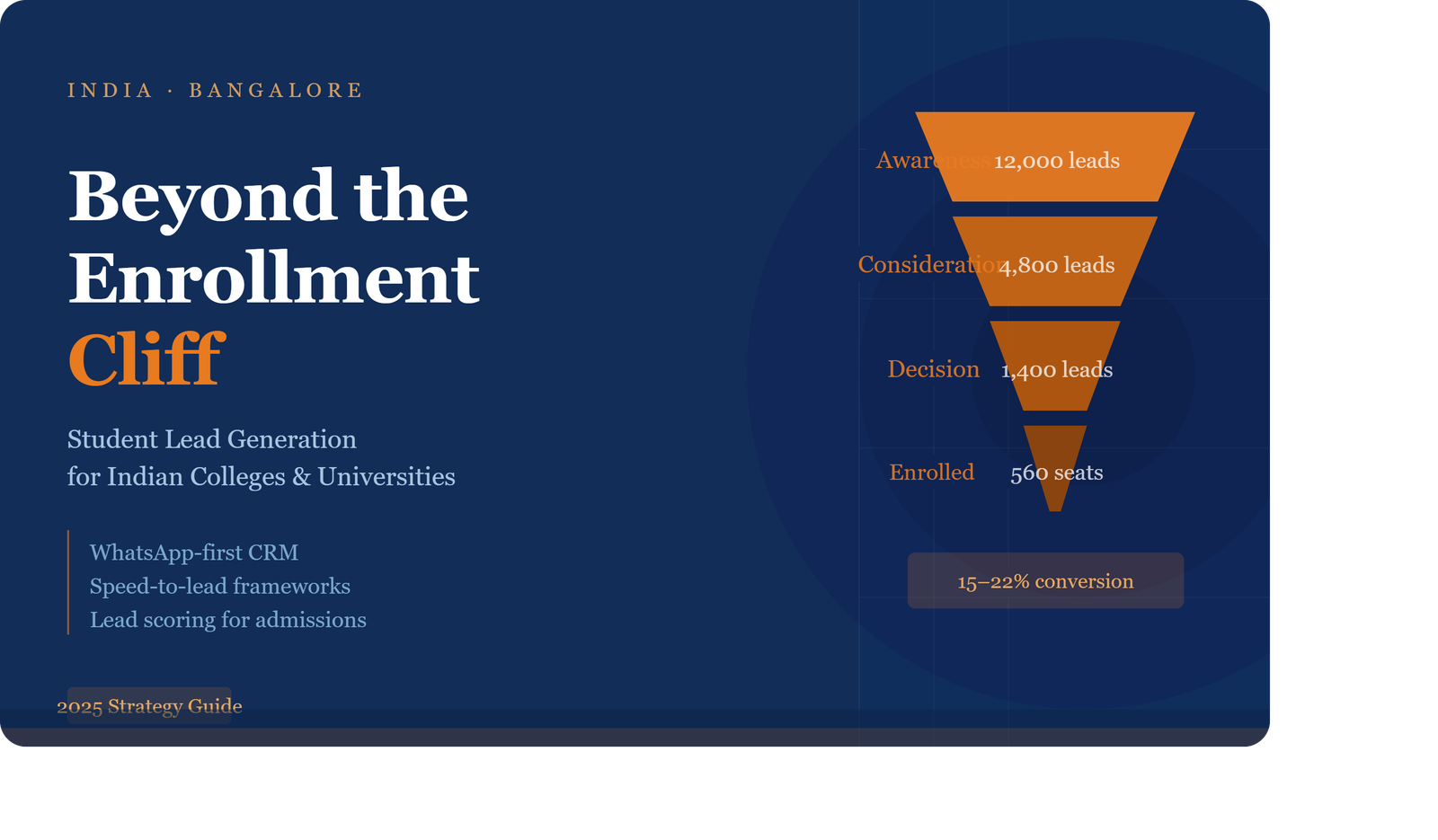
The Indian Student Journey Has Three Distinct Stages — Most Institutions Only Address One
If you’ve been treating every prospective student the same way — sending the same brochure, the same follow-up call, the same “Apply Now” push — you’re losing students at every stage without knowing it.
Building a complete funnel mirrors our foundational Healthcare Digital Marketing frameworks: you must stop pushing hard for commitment from students who haven’t yet decided what they want to study, let alone where. That pressure doesn’t convert — it drives them to your competitors who are more patient and more useful.
Stage 1: Awareness — The Exploration Phase
This is where a Class 11 or Class 12 student, or a working professional considering an MBA, is asking broad questions. What career paths are available after B.Com? What is the difference between B.Tech CSE and B.Tech AI? Which cities in India have the best tech job markets after graduation? They are not searching for your institution’s name. They’re searching for answers. And they’re finding them on YouTube, on Quora, on Telegram study groups, and on Instagram Reels from current students at colleges they’ve vaguely heard of. Your job at this stage is not to sell your institution — it’s to show up in those searches and conversations and provide genuinely useful information. Think of it this way: if a Class 12 student in Bengaluru searches “scope of BCA vs B.Sc Computer Science in Bangalore,” and your institution’s blog or YouTube channel answers that question clearly, you’ve just entered their consideration set without spending a single rupee on advertising.
Stage 2: Consideration — The Comparison Phase
Now the student has a shortlist. They’re comparing fee structures, looking at NIRF rankings, reading placement reports on LinkedIn, and watching vlogs from seniors at two or three institutions on their shortlist. They’re visiting specific program pages on your website — and if those pages are slow to load, difficult to navigate on a phone, or don’t directly answer their questions about placements, hostel facilities, and scholarship eligibility, they leave and don’t come back.
This is the stage where offering real value in exchange for contact information works. A downloadable placement report, a detailed fee-and-scholarship guide, a virtual campus walkthrough — these are the assets that convert a passive researcher into a named lead your admissions team can nurture.
Stage 3: Decision — The Commitment Phase
The student is now comparing final shortlisted options. They’re looking at merit cutoffs, seat availability, hostel allotment timelines, and reading reviews on platforms like Shiksha, Collegedunia, and Google Maps. Parents are now actively involved — in India, the family unit rarely makes college decisions without parental input, and that’s not a complication, it’s a channel you can use. At this stage, speed and human touch matter more than any marketing campaign. A student who submits an inquiry form at 9 PM on a Sunday and receives a personalized WhatsApp message within five minutes is far more likely to enroll than one who gets a generic email at 10 AM on Monday. The principle that connects all three stages: Stop sending every prospective student the same message. Match your content, your channel, and your call-to-action to where each student is in their decision journey. Awareness gets useful information. Consideration gets structured tools and resources. Decision gets fast, personal, human outreach.
The Digital Channels That Actually Work for Indian Student Acquisition
Search: Your Highest-Intent, Lowest-Cost Channel
When a student in Bengaluru types “best MBA colleges in Bangalore with placement above 10 LPA” into Google, they have already decided they want an MBA. They’re now deciding where. If your institution doesn’t appear in those results, you’ve lost a high-intent prospect to a competitor before the conversation even started.
Search engine optimization (SEO) remains the highest-quality, most cost-efficient source of student inquiries in India — but most institutions are doing it wrong. They optimize for their own institution’s name, not for the questions their prospective students are actually asking.
What actually moves rankings:
Mobile speed is non-negotiable. India has over 750 million smartphone internet users, and more than 75% of education-related searches happen on mobile. If your site takes more than three seconds to load on a 4G connection in Tier-2 cities like Mysuru, Hubli, or Coimbatore, you’re losing a significant share of your prospective student base before they read a single sentence.
Program-specific landing pages convert far better than generic homepages. When a student clicks a search result for “B.Tech CSE with AI specialization in Bangalore,” send them to a page specifically about that program — with curriculum details, faculty profiles, placement statistics, and a short inquiry form. Short means five fields or fewer: name, phone number, email, program of interest, and city. Every additional field you add meaningfully drops form completion rates.
Answer-first content works. Create blog content, FAQ pages, and YouTube videos that directly address what your prospective students are searching for: “Is NIRF ranking important for placements?” “What’s the difference between deemed university and autonomous college?” “How do I get admission to MBA without CAT score?” These pull in high-intent students who are actively researching — students your competitors aren’t reaching because they’re only targeting branded keywords.
WhatsApp: India’s Most Underutilized Admissions Channel
Here’s something most admissions teams don’t treat as a formal strategy: WhatsApp is where Indian students and parents actually make decisions.
Family WhatsApp groups share shortlisted colleges. Students ask seniors questions on batch WhatsApp groups. Parents forward admission notifications to each other. And yet most institutions treat WhatsApp as an informal afterthought rather than a structured lead nurturing channel.
WhatsApp Business API integration with your CRM allows you to send personalized, automated messages the moment a student submits an inquiry — with their name, their program of interest, a helpful document, and a direct link to book a call with a counselor. Response rates on WhatsApp consistently run two to three times higher than email for this demographic in India.
This is the Indian equivalent of the SMS-first strategy used by US institutions — but significantly more powerful because WhatsApp is where your audience already lives.
Social Media: Match Your Platform to Your Student Segment
Note for admissions teams still running TikTok-equivalent budgets: TikTok is banned in India. The short-video audience moved to Instagram Reels, YouTube Shorts, and domestic platforms like Josh and Moj. Your social strategy needs to reflect this reality.
Here’s how to allocate your social media presence based on your target student segment:
| Platform | Primary Age Group in India | Best Use for Institutions |
| Instagram Reels | 18–28 | Campus life content, student testimonials, day-in-the-life videos, faculty spotlights |
| YouTube | 15–35 | Long-form campus tours, placement success stories, faculty webinars, program explainer videos |
| All ages | Direct nurturing, document sharing, parent communication, one-on-one counselor follow-up | |
| 22–40 | MBA, executive education, online certification programs, alumni placement showcases | |
| 28–45 | Parent-targeted content, fee structure posts, scholarship announcements, community groups | |
| Josh / Moj | 15–22 | Regional language short videos; effective for Tier-2 and Tier-3 city recruitment |
The critical execution insight for Indian social media: native lead ad formats” “For comprehensive campaigns that scale cross-platform, coordinating these with structured Healthcare PPC Ads ensures your search budget focuses exclusively on high-intent parent and student keywords., pre-filling fields from their profile where possible. For a student in a Tier-2 city on a variable data connection, that reduction in friction is the difference between a captured lead and a bounce.
Turn Your Website Visitors into Identified Leads
Your institution’s website is almost certainly getting more traffic than your inquiry forms reflect. Students are browsing your program pages, your fee structure, your placement statistics — and leaving without identifying themselves. The goal is to give them a compelling reason to share their contact information before they’re ready to apply.
Virtual Campus Tours That Generate Real Inquiries
For students from smaller cities like Davangere, Shivamogga, Bellary, or from states like Odisha, Bihar, and Jharkhand who are considering relocating to Bengaluru for their degree, a virtual campus tour often functions as the first real experience of your institution. A well-produced tour — covering hostels, labs, classrooms, canteens, and campus culture — can be the single experience that moves a student from “considering” to “shortlisted.”
But the tour itself isn’t the lead generation mechanism. The strategy around it is. Four approaches work, each with different trade-offs:
| Strategy | How It Works | Best For |
| Gated Tour | Student submits name and phone number before accessing the tour | High volume of direct leads; best when institution already has strong brand recognition |
| Pop-Up Inquiry Forms | Contextual forms appear at specific points in the tour — near the hostel wing, the placement cell, the lab facilities | Less friction; captures students at the moment of highest interest |
| Physical Visit CTA | Tour ends with a call to book an in-person campus visit | Best for students who are already deep in the consideration stage |
| Topic-Specific Inquiry Links | Placement cell section links to a placement-specific inquiry form; hostel section links to accommodation inquiry | Highest lead quality; routes students to the right counselor automatically |
For institutions with national-level recruitment goals, the gated approach generates the most raw leads. For Bengaluru-based institutions targeting students within Karnataka, the topic-specific approach tends to generate more qualified inquiries because it captures what the student actually cared about.
Peer Chat: The Trust Signal Your Competitors Are Ignoring
A consistent finding across Indian student research is that 78% of prospective students rate the ability to speak directly with a current student as a critical factor in their college decision. Not a nice-to-have. A deciding factor.
Gen Z students in India have grown up in an environment saturated with institutional marketing — college brochures, sponsored content, heavily produced admission videos. They’re sophisticated enough to filter it out. What they trust is a real student telling them what hostel life is actually like, whether the placement cell actually delivers, and whether the faculty are approachable.
Peer chat tools like Unibuddy, when placed directly on your program pages, allow prospective students to start a real conversation with a current student ambassador — and that conversation captures contact information through the initiation flow. It builds trust and generates leads simultaneously.
If your institution isn’t running a structured peer ambassador program with a chat integration on your website, you’re handing a significant trust advantage to competitors who are.
Speed-to-Lead — Where Indian Admissions Teams Are Losing Enrollments They’ve Already Won
This is the part of the guide that should genuinely worry you, because the data is stark and the fix is entirely within your control.
78% of prospective students choose the institution that responds to their inquiry first.
Not the institution with the best NIRF ranking. Not the one with the highest placement package. The one that responded first.
In the Indian context, where a motivated Class 12 student or MBA aspirant may be researching six to eight institutions simultaneously, the speed of your response is often the deciding factor — especially for students in Tier-2 and Tier-3 cities who don’t have the luxury of visiting multiple campuses before choosing.
The target response window is five minutes. Not five hours. Not the next business day. Five minutes from the moment a student submits an inquiry, your system should have already assigned that lead to a counselor and sent an automated WhatsApp message acknowledging their interest.
That first message sets the relationship. It should always contain exactly these five elements:
- A warm, immediate acknowledgment — using the student’s name, not a generic “Dear Applicant.” “Hi Priya, thanks for reaching out about our B.Tech CSE program” lands completely differently than “Your inquiry has been registered.”
- A direct reference to their specific program interest — they want to know you saw what they cared about, not that they went into a generic funnel.
- One immediately useful piece of content — a placement report for their program, an alumni success story, a scholarship eligibility guide. Something that adds real value in the moment.
- A low-pressure next step — “Would you like to schedule a 10-minute call with our admissions counselor?” works far better than “Book a full campus visit.” Smaller commitment, higher uptake.
- A real human’s name and photo — the counselor who will be following up. This single detail meaningfully increases response rates because it converts an institutional interaction into a human one.
Lead Scoring: Stop Wasting Your Counselors’ Time on the Wrong Students
An admissions counselor in a mid-sized Bengaluru institution might be managing 200 to 400 active inquiries during peak season — from January to June. Without a systematic prioritization model, they’ll spend equal time on a student who downloaded one PDF six weeks ago and a student who has visited the fee structure page four times this week, attended an online info session, and started filling out the application form.
That misallocation of attention is where enrollments are lost.
A lead scoring model, built into your CRM, automatically calculates a priority score for every lead based on who they are and how they’ve engaged with your institution. Here’s a framework calibrated for the Indian higher education context:
Demographic Fit (30% of total score)
- Program of interest matches your offerings: +25 points
- Location within your primary recruitment geography (e.g., Karnataka and adjacent states for a Bengaluru institution): +15 points
- Family income / financial indicators suggest tuition fit: +10 points
Behavioral Intent (50% of total score)
- Started the application form: +50 points
- Attended a webinar, info session, or open day: +40 points
- Downloaded a placement report or program guide: +30 points
- Visited the fee structure or scholarship page: +25 points
- Visited the website 5 or more times: +20 points
- Opened 3 or more nurture emails or WhatsApp messages: +15 points
Recency (20% of total score)
- Active on site in the last 7 days: +20 points
- Active in the last 30 days: +10 points
- No activity in 60+ days: −10 points
- No activity in 90+ days: −20 points
Route leads into four action tiers based on their total score:
- Hot Leads (80+ points): Assign directly to a senior counselor. Phone or WhatsApp call within 2 hours.
- Warm Leads (50–79 points): Begin your structured welcome sequence. Attempt contact within 24 hours.
- Cold Leads (20–49 points): Enter long-term nurture track with monthly useful updates — NIRF ranking announcements, scholarship deadlines, alumni spotlights.
- Unqualified Leads (under 20 points): Quarterly newsletter only. Monitor for any reactivation signals.
This model doesn’t require an expensive CRM. LeadSquared, which has strong penetration among Indian educational institutions, supports this type of scoring natively. So do several mid-market alternatives. The system matters less than the discipline of actually using it.
Strategies by Student Segment
The frameworks above apply broadly, but three specific student populations in India require meaningfully different execution.
EdTech and K-12 District Sales (B2B)
If your institution is selling programs, curriculum tools, or platforms to school systems or K-12 networks rather than recruiting students directly, you’re in a relationship-driven B2B market with long sales cycles and concentrated decision-making authority.
India’s K-12 institutional landscape is distinct from the US model: you’re often dealing with private school chains, CBSE/ICSE board-affiliated groups, state government procurement processes, and increasingly, edtech partnerships with district-level school boards. Each has its own procurement calendar and approval hierarchy. The most important insight here is that timing matters more than messaging. State government schools plan curricula before the academic year begins — typically April to June for the following year. Private school chains often finalize vendor relationships during summer break. If you miss that window, you wait a full year.
Decision-making authority runs through three distinct personas, each requiring different content:
| Decision-Maker | Primary Concern | Most Effective Content |
| School Principal / Director | Student outcomes, teacher adoption, classroom impact | Video testimonials, implementation case studies, peer school references |
| Academic Coordinator | Curriculum alignment, ease of integration | Program syllabi, sample lesson plans, pilot program proposals |
| Trustee / Management Committee | ROI, regulatory compliance, brand value | Financial outcome reports, compliance documentation, top-school affiliations |
In Indian private school networks, the trustee or management committee often holds final purchasing authority even when day-to-day academic decisions rest with the principal. Building relationships at both levels — not just with the academic gatekeeper — is what separates closed deals from stalled ones.
Vocational and Skill Development Institutions
Students seeking vocational or skills-based training in India — whether through ITIs, polytechnics, private skill development centers, or government schemes like Skill India — have a fundamentally different psychology than traditional degree aspirants.
They want one thing above everything else: a direct, fast, credible path to employment. They compare tuition costs and local job placement rates with the same urgency a first-generation earner applies to any investment. And they make decisions quickly. Delay your response and they’ll sign up with whoever called them back first.
The response-time dropout data for this segment is stark:
| Response Time | Estimated Lead Dropout Risk |
| Under 5 minutes | ~8% |
| Within 1 hour | ~21% |
| Within 4 hours | ~38% |
| Same day | ~55% |
| Next day | ~74% |
| 3+ days | ~91% |
For vocational programs where margins are thinner and competition from government-subsidized schemes is real, many institutions in India partner with outsourced admission calling teams to ensure every inquiry gets a live response within minutes. The cost of that infrastructure is almost always less than the cost of losing a qualified lead to a competitor.
Content that resonates with this segment: localized salary data, direct testimonials from placed students with actual employer names and CTC figures, total cost-of-program breakdowns, and EMI or installment payment options prominently displayed.
Graduate and Executive Education (MBA, PG Programs)
The pipeline challenge for graduate programs in India is evolving. CAT and MAT scores — historically the primary way institutions identified and purchased leads from high-intent MBA aspirants — are becoming less reliable as the landscape fragments. Direct applications are increasing. Alternate pathways like institution-specific entrance tests and management quota processes are gaining share. And more working professionals are bypassing standardized tests entirely in favor of experience-based admissions for executive programs.
For this segment, the shift is toward behavioral targeting rather than list purchasing. Consumer database platforms and LinkedIn audience targeting allow institutions to identify working professionals in Bengaluru and other metro cities who match the profile of their best-performing alumni — by industry, seniority, employer, and years of experience — and reach them before they’re actively in-market.
Adult learners and working professionals who are considering a part-time MBA or executive certification are doing serious, independent research. They want to know: Will this credential actually move the needle on my salary or career trajectory? Can I manage this alongside a full-time job? How do faculty engage with the real business challenges I’m already dealing with?
Content that converts for this audience is direct and outcome-focused. Not “Experience the best in management education.” Rather: “Our 2024 batch recorded a 34% average salary increase within 18 months of graduation. Here’s how they got there.” Specificity builds credibility with this audience in a way that no amount of campus photography can replicate.
The Three Numbers That Tell You Whether Any of This Is Working
Strategy without measurement is guessing. These three metrics give you a clear, honest picture of your enrollment pipeline health.
1. Lead Velocity Rate (LVR)
LVR measures how fast your qualified lead pipeline is growing month over month:
LVR = ((Current Month Leads − Previous Month Leads) ÷ Previous Month Leads) × 100
A consistent positive LVR tells you your pipeline is growing sustainably. A flat or declining LVR — even if current enrollments look healthy — is an early warning sign of a future enrollment shortfall. Track it monthly, not annually.
2. Stage-to-Stage Funnel Conversion Rate
This tells you what percentage of leads are actually advancing through your pipeline:
Conversion Rate = (Leads That Advance ÷ Total Active Leads in Stage) × 100
Track this at every transition point: inquiry to application, application to document submission, document submission to seat confirmation, seat confirmation to fee payment. A sharp drop at any single stage is a specific problem with a specific fix — not a general “we need more leads” problem.
3. Benchmark Against India-Relevant Standards
These benchmarks reflect what well-run enrollment operations in Indian higher education actually achieve. They’re calibrated for the Indian market — not US or European contexts:
| Metric | Healthy Benchmark (India) | Alert Threshold |
| Inquiry-to-Enrollment Rate | 12% – 22% | Below 8%: audit your nurture and follow-up process |
| Cost per Enrollment (INR) | ₹3,000 – ₹8,000 | Above ₹12,000: review your lead source quality |
| Average Days to Convert | 21 – 45 days | Above 60 days: investigate where and why leads are stalling |
If your cost per enrollment is consistently above ₹12,000, the problem is almost never “we need a bigger advertising budget.” The problem is either lead source quality (you’re attracting students who were never a fit), speed of response (you’re losing high-intent leads to faster competitors), or content relevance (your follow-up materials aren’t answering the questions students are actually asking).
The Bottom Line: The Enrollment Cliff Isn’t Coming — It’s Already Here
Indian institutions are operating in a market that looks nothing like it did five years ago. More competitors, more digitally sophisticated students, shrinking attention spans, and a generation that researches silently for months before ever submitting an inquiry form.
The students you need to reach are out there — browsing Instagram Reels from your campus, comparing your placement report to a competitor’s on Shiksha, asking your alumni questions on LinkedIn, debating your institution in college WhatsApp groups they joined before they’d even spoken to your admissions team.
The question isn’t whether they’re researching. The question is whether your institution’s digital infrastructure is built to find them, engage them, and convert them — before a competitor with a faster response time and a better mobile experience does it first.
Fix the top of the funnel: mobile-first program pages, native social lead ads, peer chat on your program pages, SEO content that answers real student questions in Kannada-English code-switch contexts as well as pure English.
Fix the middle: WhatsApp-first nurture sequences, virtual tours with contextual inquiry forms, downloadable placement reports gated behind a short form.
Fix the bottom: a real-time lead scoring model, a five-minute response target enforced through CRM automation, and senior counselors spending their time on the 20% of leads that are genuinely close to a decision.
That is the shift. Not a new campaign — a new operating model.
Our team works directly with admissions offices across Bengaluru and pan-India to build custom student acquisition frameworks, WhatsApp-first CRM workflows, and lead-scoring models tailored to your institution’s programs and target student population.
[Book a Free Pipeline Audit] — [Download the India Enrollment Strategy Checklist]
Works Cited
- Higher Education Marketing: Strategies to Boost Enrollment and Engagement 2026 — walls.io
- A Full-Funnel Marketing Guide for Higher Education — EducationDynamics
- Best Lead Generation Strategies for Higher Education in 2026 — Manaferra
- 4 Ways Virtual Campus Tours Generate Student Leads — Concept3D
- Higher Ed Recruitment On A Smaller Budget — Unibuddy
- Speed-to-Lead for Schools: Faster Admissions Follow-Up — higher-education-marketing.com
- Lead Generation For Educational Institutions In 2026: Complete Guide — anirup.com
- K-12 Lead Generation: Build Your Education Sales Funnel — tamtotarget.com
- Why Enrollment Teams at US Colleges Are Outsourcing Student Lead Qualification to Contact Centers — Boomsourcing
- Higher Education Lead Nurturing: How To Increase Enrollments — LeadSquared
- Data-Powered Student Recruitment Strategies for Higher Ed — Ellucian